


NEWS
AI and academic publishing: protecting scientific integrity in a changing landscape
Published Date – 18 November 2026
Artificial intelligence is rapidly changing how scientists conduct, write, review, and publish research. But as AI becomes increasingly embedded in academic publishing, an important question remains: how can researchers benefit from these powerful tools without compromising scientific integrity or losing the human skills that underpin good science?
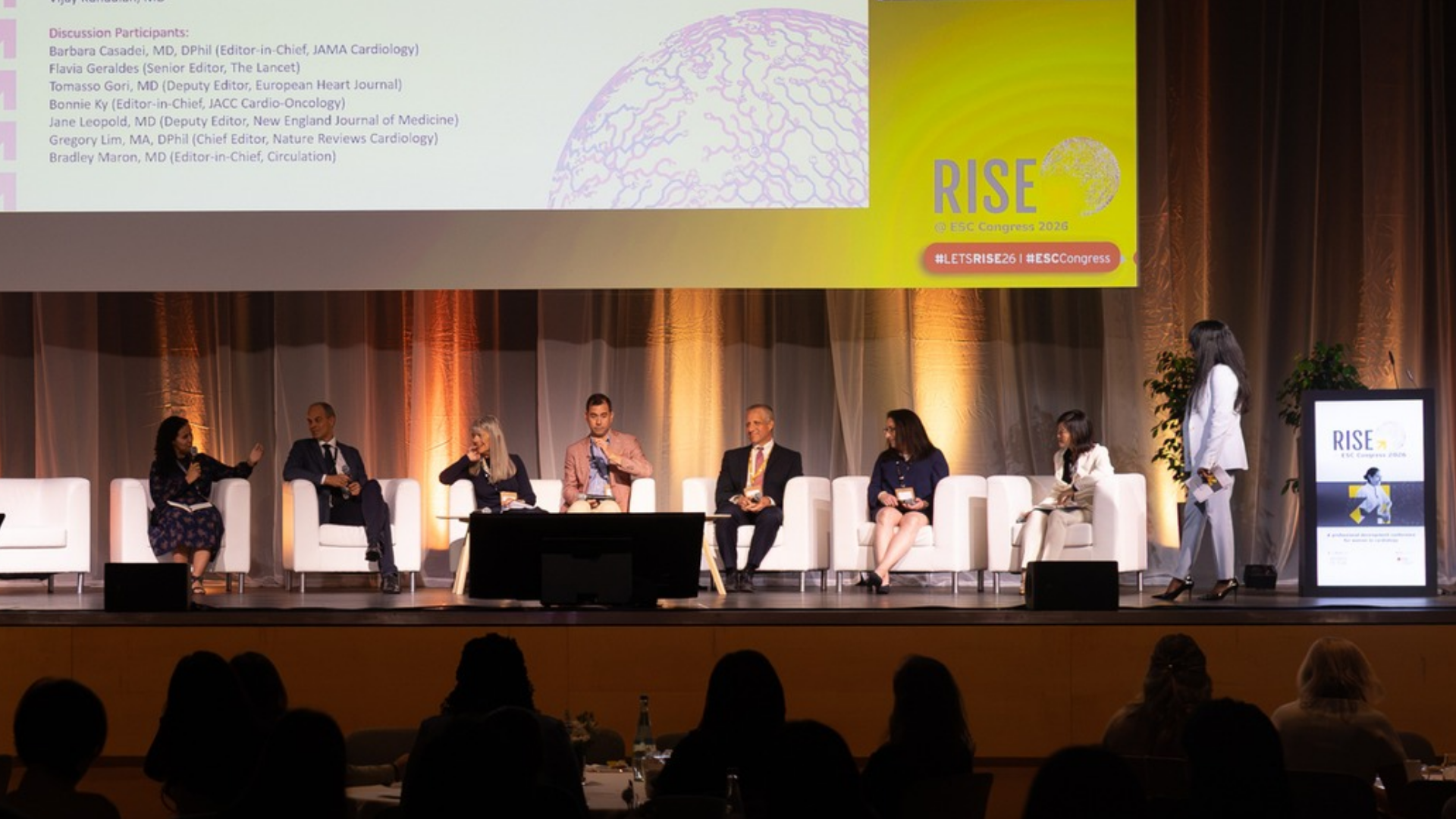
At RISE @ ESC Congress 2026, a panel of editors representing leading cardiovascular and medical journals discussed this challenge.
AI is a tool, not a substitute for thinking
Opening the discussion, the panel highlighted the importance of developing human intelligence and scientific skills, particularly among early-career researchers.
“You can use it to polish your language, but you cannot use it to write a viewpoint, an editorial, a letter, a draft, a paper, let alone making up data, but you can use it sometimes to help you with figures,” explained Barbara Casadei, MD, DPhil, Editor-in-Chief, JAMA Cardiology.
Writing, analyzing data, and developing scientific arguments are not simply tasks to be completed. AI can speed up processes, but the panel cautioned against outsourcing the thinking itself. AI cannot determine what is scientifically important. Human researchers must remain responsible for the ideas, interpretation, and conclusions.
“We need to protect our patients and really think about why we went into science in the first place when we are leveraging AI. Not taking shortcuts but really ensuring that you are taking 100% full responsibility and making yourself more agile,” said Bonnie Ky, MD, MSCE, Editor-in-Chief, JACC: CardioOncology.
The emerging consensus is not to reject AI, but to use it as an assistant rather than a replacement for human intelligence.
We need to protect our patients and really think about why we went into science in the first place when we are leveraging AI. Not taking shortcuts but really ensuring that you are taking 100% full responsibility.
Bonnie Ky, MD, MSCE, Editor-in-Chief, JACC: CardioOncology
“Our keynote speaker [Lotte Bjerre Knudsen, DMSc] said, ‘Scientists will not be replaced by artificial intelligence,’ so we still need to keep using our human intelligence. But scientists, she said, who don’t use AI will be replaced. So, AI is here we must all learn how to do it, but it must not replace what we can do,” Vijay Kunadian, MBBS, MD, said.
Transparency is essential
Across the journals represented on the panel, one principle was consistent: authors must disclose how they have used AI.
“What we really want to know is whether or not the authors have used AI in their writing, in their critical thinking, and what part of their submission is attributable to AI,” said Jane Leopold, MD, Deputy Editor for cardiology, The New England Journal of Medicine. “AI can clean up the packaging of a submission, but AI can’t determine what’s important, and that’s where the editors come in.”
Many journals now require authors to declare whether AI was used during submission and, if so, for what purpose. This does not mean a manuscript will be rejected. Instead, transparency allows editors to understand how the work was produced and apply appropriate safeguards.
Gregory Lim, MA (Oxon.), DPhil, Chief Editor, Nature Reviews Cardiology made it clear, “We need to know that AI has been used in the preparation of figures or in the preparation of the text, and then we can respond accordingly.”
The panel distinguished between language editing, which can help researchers write in a second language, and the generation of scientific content. The panel emphasized that authors must retain full responsibility for their work regardless of the tools they use. AI-generated material must be checked carefully, and researchers must be able to stand behind the accuracy, originality, and integrity of their submission.
AI can clean up the packaging of a submission, but AI can’t determine what’s important, and that’s where the editors come in.
Jane Leopold, MD, Deputy Editor for cardiology, The New England Journal of Medicine
Peer review presents a new challenge
The conversation also revealed a less-discussed issue: AI within peer review. Editors are increasingly encountering reviews that may have been generated with AI, raising questions about fairness, independence, and confidentiality.
“The external peer review process should be held to the same standard as the authors,” said Bradley Maron, MD, Editor-in-Chief, Circulation, who added, “If you feel that AI has been used to generate reviews either unfairly or in a biased way, let us know so that we can take a look and partner with the authors to assess the situation.”
Panelists stressed that confidential manuscripts should not simply be uploaded into publicly available AI systems. Reviewers are entrusted with unpublished scientific work and protecting that confidentiality is fundamental to the peer-review process.
“We ask our peer reviewers not to use AI tools in the preparation of their comments and their reviews because it’s an unpublished manuscript, it’s confidential, and by putting it into a large language model you’re essentially disclosing that and it’s being made public,” Dr. Lim explained.
The panel also discussed the possibility of AI eventually supplementing human peer review, with some journals exploring this through research. But the panel was clear that human judgment remains essential.
Preserving skills for the next generation
Perhaps the most important concern raised was what AI means for researchers who are still learning. For early-career physicians and scientists, drafting manuscripts, refining arguments, and interpreting results helps build the judgment and expertise needed for a successful research career.
“We still always need humans in the loop. We can’t take shortcuts with thinking. That is such a great travesty, especially for the young minds out there, those that are learning; you need to take the time to think through everything,” implored Dr. Ky.
Researchers and educators will need to teach new scientists to use AI critically and judiciously, while ensuring they first develop the underlying skills to evaluate its output.
“Everything you ask AI to do; you’re not doing yourself. So, you’re not developing your skills. But in the future, ideally, we can be augmented by AI; we have it as a tool. Just like we have so many other tools, but without losing the skills,” explained Flavia Geraldes, Senior Editor, The Lancet Group.
AI is evolving rapidly, and journal policies and guidance are changing as new applications emerge. However, what seems possible today may look very different in a few years, raising questions about how we should use AI now and how its role will evolve over time.
Tommaso Gorri, MD, PhD, Deputy Editor, European Heart Journal, highlighted, “It’s a moving threshold; we don’t know what’s going to be allowed in 5 years, 10 years. We have no idea.”
This is a tool that needs to be used judiciously, but the tool is not going to go away, and so we need to find a way to use it in a way that we retain our voice.
Barbara Casadei, MD, DPhil, Editor-in-Chief, JAMA Cardiology
Keeping humanity at the center
Although AI’s future role remains uncertain, the panel was clear that researchers who learn to use it effectively will be better equipped for the future. But technological capability cannot replace scientific curiosity, critical thinking, creativity, ethics or responsibility.
As Dr. Casadei stated, “We must be realistic. This is a tool that needs to be used judiciously, but the tool is not going to go away, and so we need to find a way to use it in a way that we retain our voice. It has taken me a long time to find my voice, and now I don’t want to write or talk like a bot.”
The future of academic publishing will undoubtedly involve AI. Our responsibility now is to ensure human intelligence remains at the heart of science and integrity remains non-negotiable.
Grow with a changing research landscape
As science evolves, keep building your skills and connections with The Pulse, Women As One’s community for women in medicine.
Latest News
AI and academic publishing: protecting scientific integrity in a changing landscape
RISEA panel of journal editors at RISE @ ESC Congress 2026 discussed the challenges and opportunities of AI in academic publishing.

Design your future career: turning goals into strategic action
RISEAt RISE @ ESC Congress 2026 attendees learned how to set bold goals for their careers and how to take strategic action to achieve them.

Building a more inclusive clinical research ecosystem: from visibility to action
RISEIndustry leaders discuss how clinical research can transform patient care during a panel discussion at RISE @ ESC Congress 2026.